Bengaluru Has Too Many Unsold Homes. Here Is What That Means for Buyers
Market Trends · 21 October 2026
Unsold stock in Bengaluru is up 22% to 34% in a year, and almost every new launch is priced above ₹80 lakh. Buyers have more choice, and more ways to get it wrong.

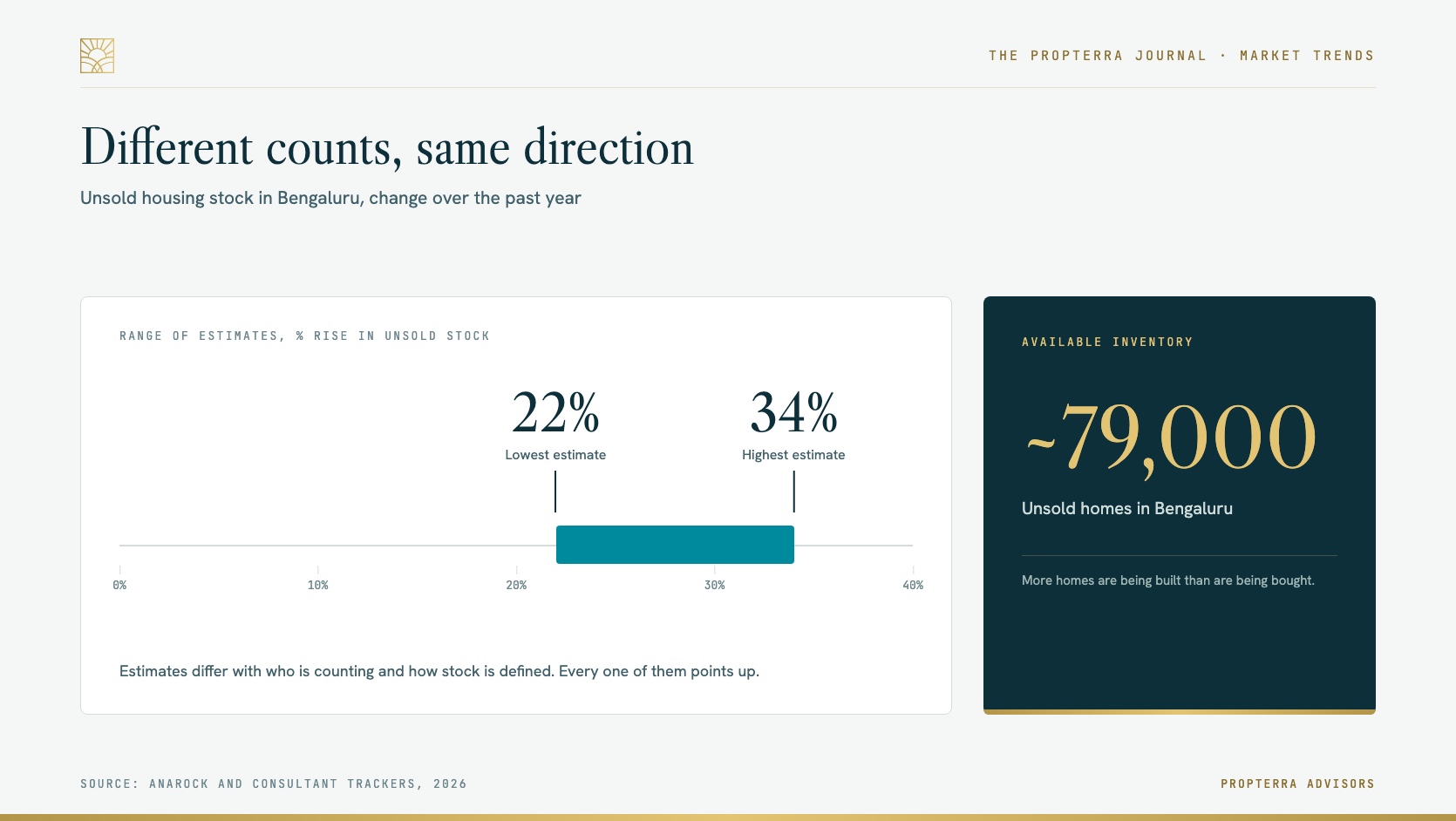
Ask three consultants how much unsold housing Bengaluru is carrying and you will get three different answers. Over the past year, unsold stock has grown by somewhere between 22% and 34%, depending on who is counting and how. The most recent Anarock data puts available inventory at roughly 79,000 units. The numbers differ, but they point the same way: more homes are being built than are being bought.
Where the pile is building up
The second fact matters more than the first. Almost every new launch in the city is priced above ₹80 lakh. The cheaper end has largely stopped being built, so the stock that is piling up sits in the price range where buying a home is the biggest financial decision a household makes. A buyer at ₹1.2 crore is not browsing. They are taking a home loan that may run fifteen or twenty years, against a handover that could be three or four years away.

More choice is not the same as better choice
When supply was tight, the risk for a buyer was missing out. People rushed, and the cost of rushing showed up in the price. With stock building, the risk flips. A single corridor now has dozens of projects that look alike, each with a render, a clubhouse and a launch offer. Choosing between them takes work that most buyers have no time for: comparing carpet-area prices, reading the RERA filings, checking what the developer has actually delivered before, and asking why a tower is still half-sold two years after launch.
Unsold stock is also not always a warning. Sometimes a project is slow because it launched at the wrong price, or because the metro line next to it is still on paper. Sometimes it is slow because the developer is. The headline count cannot tell you which, and a brochure will not either.

Developers have the same problem from the other side
A developer with unsold units needs buyers, and needs them in a market where buyers are getting more careful. Many respond with more selling: bigger offers, more channel partners, more urgency. Some of that is fair. But a buyer who senses pressure tends to walk away, and a project sold through pushy tactics often pays for it later in poor referrals. Developers with good projects are better served by buyers who have done their homework and are likely to see the purchase through.
The gap in the middle
Most real estate intermediaries in India were built to distribute. They are good at putting a developer’s inventory in front of people. That model made sense when demand ran ahead of supply and the hard part was reaching enough buyers. It fits less well now. A distributor’s incentive is to close whatever is on its list. A buyer wants to know which of the forty options deserves their money, and sometimes the honest answer is none of them yet.
An advisor works the other way round. Start with the buyer’s budget, timeline and plans for the home, then work back to the few projects that fit, and be willing to drop the ones that do not. It is slower, and it means turning down some sales. It also means that when a recommendation does come, it carries weight.

What choosing well looks like right now
A few habits help whatever route you take. Compare projects on carpet-area price, not super built-up. Look at how much of a project has sold, and ask for the reason if the number is low. Check the developer’s last three deliveries against their promised dates on the K-RERA portal. Get your loan sanction in hand before you fall for a unit, and keep room in the budget for stamp duty, registration and interiors. And take your time. In a market with this much stock, patience costs little and mistakes cost a lot.

Our view
Rising unsold stock is not a crisis, and we would not call it one. Prices in the better corridors are holding and demand is real. But it does change what a buyer needs. Last year’s buyer needed access to inventory. This year’s buyer needs judgment. That is the job we think an advisor should do: help you choose, and tell you plainly when the right call is to wait. If you are weighing a purchase in Whitefield, Sarjapur Road or any other corridor we cover, talk to an advisor and we will go through your shortlist with you.